InTASC Standard #5: Application of Content
This standard emphasizes the importance of helping students apply what they learn in meaningful, real-world ways. It’s not just about knowing the content—it’s about using that knowledge to think critically, solve problems, and make connections across different subjects. That’s why I always look for ways to make learning feel relevant and engaging. For example, during our Cookie Mining activity, students practiced math skills by collecting and graphing data in a hands-on way. In our Nature Walk Reflection, we connected reading and science by identifying real-life problems and solutions in our environment. And when we explored watersheds, students used what they learned to label a Watershed Map based on their home address, making it personal and meaningful. Helping students apply what they’ve learned builds confidence, curiosity, and a stronger connection to the world around them.
Artifact #1: Cookie Mining Activity and Bar Graph
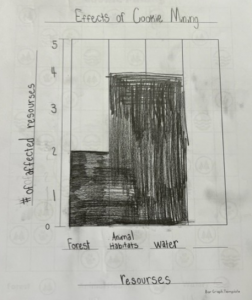
As part of our lesson on Virginia’s mineral resources, I led students through a hands-on cookie mining simulation. Each student “mined” chocolate chips from a cookie to represent how minerals are extracted from the earth. They then looked at the effect their mine had on the environment based on how much “land” they disrupted and how many animals and habitats were affected. Afterward, students created individual bar graphs to represent their mining results.
This activity encouraged students to apply math skills like graphing while connecting science content about natural resources to real-world environmental consequences. It fostered problem-solving, critical thinking, and real-world application in an engaging, cross-curricular way.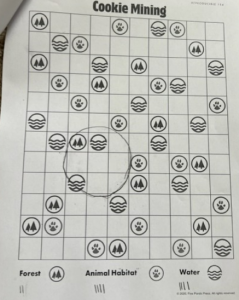
Artifact #2: Nature Walk Reflection – Problem and Solution Reflection
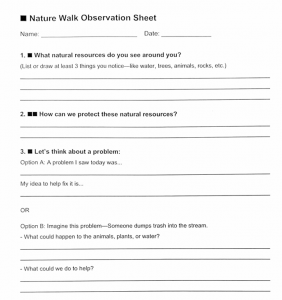
During our unit’s final week, I guided students on a nature walk around the school grounds to identify and observe local natural resources. After the walk, students discussed what they noticed, any problems they observed (such as littering or soil erosion), and proposed thoughtful solutions as part of a class reflection.
This activity helped students connect classroom content to their local environment and think critically about human impact. It gave them a chance to reflect on real-world problems and brainstorm ways to care for Virginia’s natural resources.
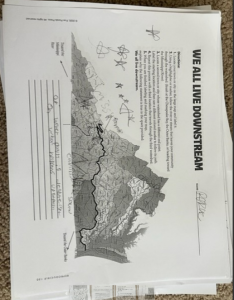
Artifact #3: Watershed Address Investigation & Labeling Map
In our lesson on watersheds, students explored the idea of a “watershed address.” Each student used an interactive watershed map of Virginia to determine which of the three major watershed systems they belonged to (Chesapeake Bay, Gulf of Mexico, or North Carolina Sound). They then traced and labeled a simplified watershed map and wrote a short explanation of what it means to live downstream.
This activity directly supported students in applying geographical and environmental science concepts to their own lives. It made abstract concepts more tangible and personalized. Students learned how their actions impact water systems and how they are connected to the broader ecological community.